Summary Which asset you attach first depends on who the debtor is. Salary is the usual first target for an employee, card sales and payment-gateway settlements for a business owner, brokerage and crypto exchange accounts for an investor, and trade receivables for a company. Before that, check three things: limitation periods, signs that assets are being moved, and whether you already hold an enforceable title.
Hello, I am Hyunwoo Shin, Managing Attorney at Law Firm Hyeongwon and a lawyer registered with the Korean Bar Association as a specialist in debt collection.
When clients ask how much they can recover, the honest answer starts with a different question: what can be attached, and in what order? A judgment does not pay you. Actual recovery depends on successfully attaching and collecting specific, non-exempt assets. This guide sets out what to check first and which assets we look at first for each type of debtor. It reflects Korean law as of 2026.
Bottom line: order matters
1) If any claim will reach its limitation period within a year, managing the deadline comes before anything else.
2) If the debtor appears to be moving assets, provisional attachment comes before a lawsuit.
3) If you already have a judgment, the task is no longer litigation. It is choosing what to attach.
4) The first target differs for an employee, a business owner, an investor and a company.
Three things to check first
1. Limitation period: is a claim about to expire?
The period depends on the type of claim.
| Type of claim | Period | Legal basis | What to check |
|---|
| Private loan between individuals | 10 years | Civil Act Art. 162 | Counted again from the last repayment or acknowledgment of the debt |
| Trade payments between merchants | 5 years | Commercial Act Art. 64 | Check the date of the last transaction |
| Construction fees, goods sold by merchants and similar | 3 years | Civil Act Art. 163 | Check the completion or delivery date |
| Claim confirmed by judgment or a final payment order | 10 years | Civil Act Art. 165 | For an old judgment, consider a new suit to extend the period |
A limitation period can be interrupted by a court claim, by attachment or provisional attachment, or by the debtor’s acknowledgment of the debt (Civil Act Art. 168). A demand letter alone is only a peremptory notice. Unless you file a lawsuit, provisional attachment or similar step within six months, it does not interrupt the period (Civil Act Art. 174). For more, see Does a Demand Letter Stop the Statute of Limitations in Korea?.
2. Signs that assets are being moved
If you see any of the following, do not wait for a judgment. Consider provisional attachment (Civil Execution Act Art. 276) to freeze assets first.
1) The debtor stops answering, or only repeats "please wait a little longer"
2) Property in the debtor’s name is listed for sale or appears to have been passed to family
3) You hear of a business closing or relocating, or see the shop being cleared out
See Provisional Attachment in Korea for timing and method.
3. Enforceable title: do you already have one?
Compulsory execution requires an enforceable title, such as a court judgment, a final payment order, or a notarized deed with consent to compulsory execution. If you already have a valid one, you can generally bypass standard litigation and proceed toward asset searches and attachment. If you do not, filing an application early can bring forward your recovery timeline considerably.
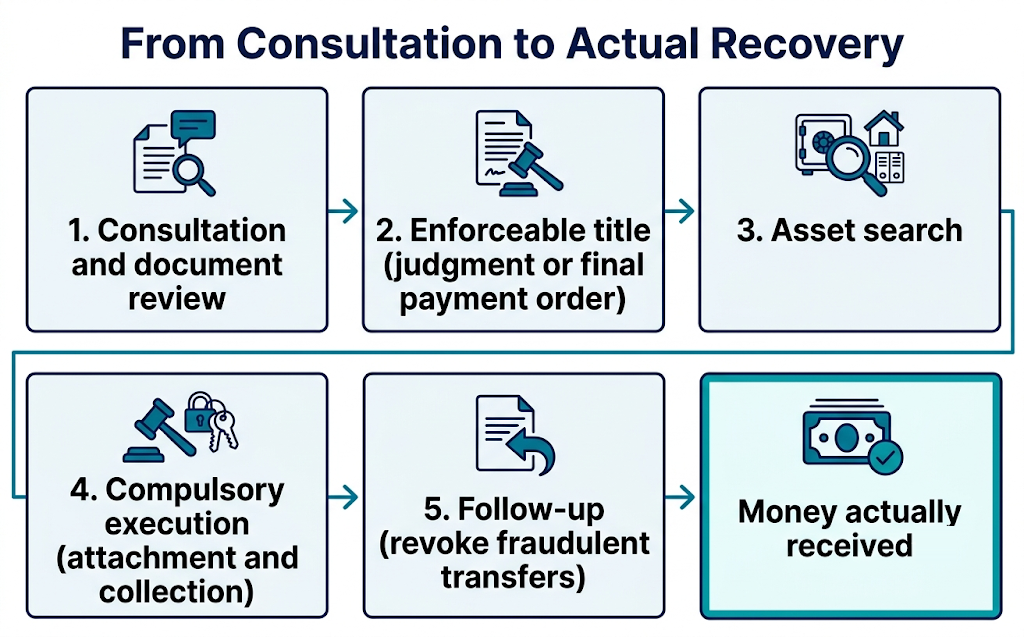
Five stages and what "finished" means at each
| Stage | Finished when | Where it often stalls |
|---|
| 1. Consultation and document review | Claim amount, limitation and debtor details are documented | Missing partial payments; unknown debtor address |
| 2. Obtaining an enforceable title | Judgment or payment order becomes final | Debtor objects; service fails |
| 3. Asset search | Attachable assets and the third-party debtors (banks, employers and so on) are identified | Debtor does not appear at the asset disclosure hearing |
| 4. Compulsory execution | Attachment and collection order served and money actually received | Insufficient funds; statutory exemption limits |
| 5. Follow-up | Transferred assets restored, or criminal proceedings pursued | Time limit for revoking a fraudulent transfer has passed |
For the full procedure, see Debt Collection in Korea: How to Actually Recover Money Owed to You.
Payment order or lawsuit?
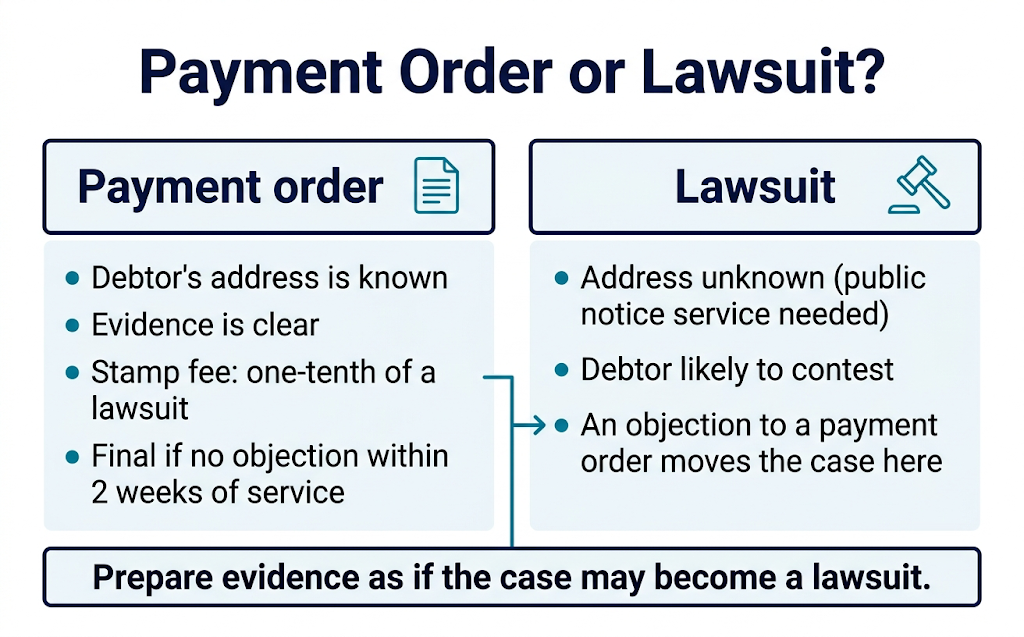
Two questions decide it.
First, is the debtor’s address certain? A payment order cannot proceed by service by public notice, so if you do not know the address, a lawsuit is the right route from the start.
Second, is the debtor likely to contest? If you have a loan agreement or transfer records, a payment order is faster, and the stamp fee is one-tenth of that for a lawsuit (Act on Stamp Duty on Civil Procedure Art. 7(2)).
If the debtor does not object within two weeks of service, the order becomes final and has the same effect as a judgment (Civil Procedure Act Arts. 470 and 474). If the debtor objects, the case moves to litigation (Art. 472). So prepare your evidence as if the case will become a lawsuit. See Payment Orders in Korea.
After judgment: finding the assets
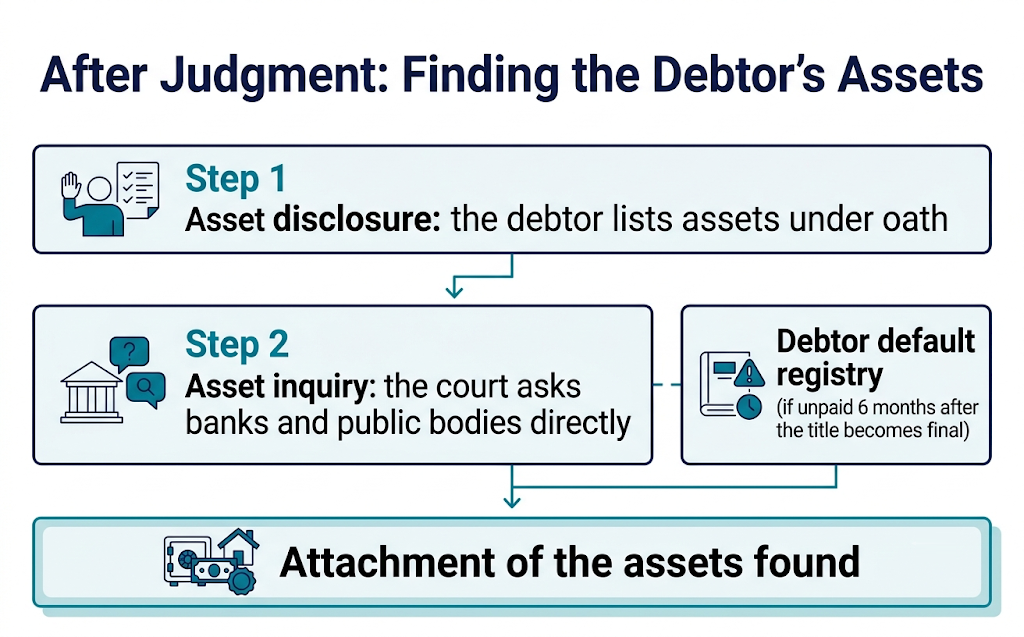
A judgment does not send you money. Recovery starts when you find and attach the debtor’s assets.
1) Asset disclosure (Civil Execution Act Art. 61): the debtor submits a list of assets to the court and swears it is true. Failing to appear without good reason or refusing to swear can lead to detention of up to 20 days, and a false list is punishable by up to three years in prison or a fine of up to KRW 5 million (Art. 68).
2) Asset inquiry (Art. 74): if disclosure is not enough, the court asks financial and public institutions directly about assets in the debtor’s name.
3) Debtor default registry (Art. 70): if the debtor has not paid within six months after the title becomes final, you can apply to have the debtor listed, which adds pressure to pay.
See How to Find a Debtor’s Assets in Korea and Won a Judgment in Korea but Still Not Paid?.
Which assets to attach first, by type of debtor
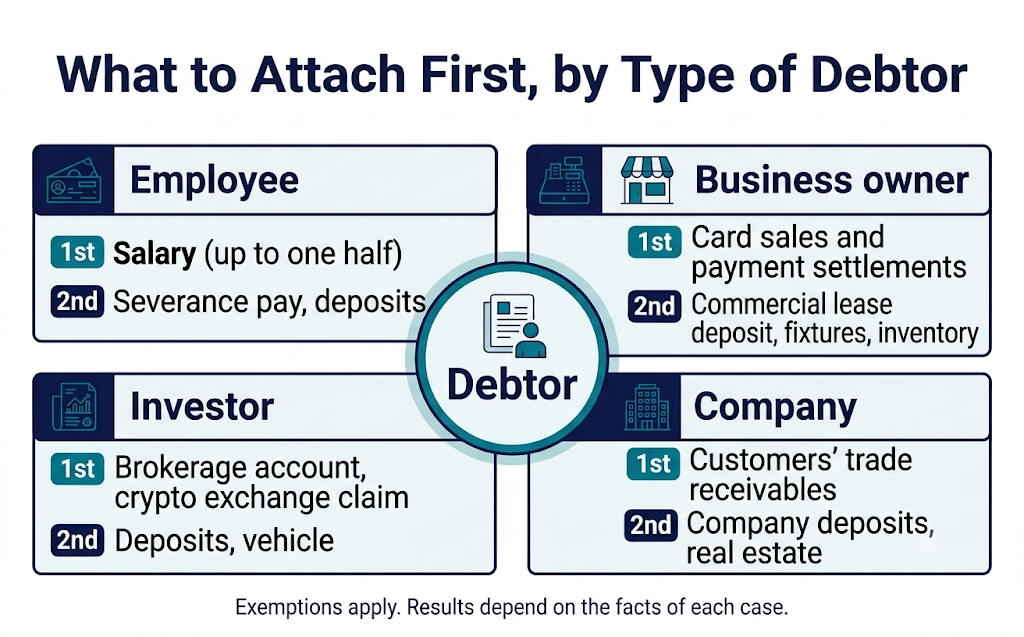
The same judgment can lead to very different results depending on where you attach first. Many debtors keep their main account nearly empty once they expect an attachment, so a single bank account attachment may not yield full recovery. Our usual order of priority is below.
| Type of debtor | First | Second | Information to gather first |
|---|
| Employee | Salary (up to one half) | Severance pay, deposits | Employer’s name; signs of social insurance enrollment |
| Sole proprietor or business owner | Card sales and payment-gateway settlements | Commercial lease deposit; shop fixtures and inventory | Business registration number; payment terminal or online shop details |
| Investor | Brokerage account; claim against a crypto exchange for return of assets | Deposits, vehicle | Brokerage or exchange used; transfer records |
| Company | Trade receivables owed by customers; company deposits | Deposited court funds; real estate | Main customers; whether it wins public contracts |
| Occupation and assets unknown | Apply for asset disclosure and asset inquiry | Attach according to the results | Address, mobile number, transfer account |
Employee debtors
As a rule, up to one half of salary can be attached, and an amount below the minimum living cost set by decree is excluded from attachment (Civil Execution Act Art. 246). Salary arrives every month, so one attachment can produce steady recovery. If the debtor changes jobs, you must apply again against the new employer as the third-party debtor, so keep checking employment information.
Business owners and sole proprietors
Settlements accumulating with card companies and payment-gateway providers are often the real cash flow, more than the bank account. A commercial lease deposit is also a good target, but you must name the landlord as the third-party debtor, and part of a small residential deposit cannot be attached (Civil Execution Act Art. 246(1)(vi)).
Investor debtors
A debtor who keeps money in a brokerage account or crypto exchange rather than a bank must be attached separately through that broker or exchange. The Supreme Court has treated bitcoin as an intangible asset with property value (Supreme Court Decision 2018Do3619, May 30, 2018). See also Crypto Investment Fraud in Korea.
Corporate debtors
A company’s money mostly comes from its customers. Attaching the amounts its main customers owe it can stop those payments and often speeds up negotiation. See Collecting Unpaid B2B Invoices from a Korean Company.
If assets were moved, check the deadlines
Assets moved away can sometimes be brought back, but the time limits are short.
1) Action to revoke a fraudulent transfer (Civil Act Art. 406): within one year of learning of the transfer and within five years of the transfer itself.
2) Obstruction of compulsory execution (Criminal Act Art. 327): hiding assets or making a sham transfer to avoid execution is punishable by up to three years in prison or a fine of up to KRW 10 million.
3) Fraud (Criminal Act Art. 347): considered where the debtor borrowed with no intention of repaying.
Whether to file a criminal complaint should be judged by whether it helps recovery, not only whether it is possible. A weak complaint that ends without charges can simply give the debtor time. See Will a Fraud Complaint Get My Money Back in Korea?.
Choosing who handles collection
The test is whether the case needs court procedures. A credit information company may press for payment and check assets within legal limits, but only a lawyer may represent you in payment orders, lawsuits, provisional attachment and attachment applications. Handling legal work for a fee without being a lawyer is a criminal offence under Article 109 of the Attorney-at-Law Act. If the debtor has started to contest, the assets are not in a bank account, or collection has stalled at the reminder stage, it is time to move to court procedures. See Choosing Who Should Collect Your Debt in Korea.
Checklist before you act
1) Put the contract or loan agreement, transfer records, messages and any recordings in one folder
2) Write down the date you last received money and any date the debtor acknowledged the debt (for limitation)
3) Write down everything you know about the debtor: employer, customers, business registration number, bank
4) Look for signs of asset transfers, and if you see any, get advice on provisional attachment first
5) If you already hold a judgment, payment order or notarized deed, prepare a copy
Frequently asked questions
Q. Where do I start if I want to recover money soon?
A. Check the limitation period and whether assets are being moved. If the deadline is near or assets are being disposed of, provisional attachment or filing a lawsuit comes first. If you already have a judgment, you can go straight to the asset search and attachment.
Q. Does sending a demand letter stop the limitation period?
A. A demand letter is a peremptory notice and does not fully stop the period by itself. You must file a lawsuit, payment order application or provisional attachment within six months for it to interrupt the period (Civil Act Art. 174).
Q. What happens to a salary attachment if the debtor changes jobs?
A. An attachment order is effective only against the employer named in it, so you must apply again against the new employer. As a rule, up to one half of salary can be attached (Civil Execution Act Art. 246).
Q. The business owner’s account is empty. Is there any way to collect?
A. Yes. Card sales and payment-gateway settlements, the commercial lease deposit, and shop fixtures and inventory can be considered. The key is finding the route through which real revenue arrives.
Q. The debtor transferred assets to a family member. What can I do?
A. An action to revoke a fraudulent transfer can cancel the transaction and restore the asset. It must be filed within one year of learning of it and within five years of the transfer, so seek advice as soon as you find out.
Q. My judgment is nearing its limitation period. Can I still enforce it?
A. A claim confirmed by judgment has a ten-year limitation period (Civil Act Art. 165). If ten years are approaching, a new suit to extend the period should be filed.
Q. Can a foreign court judgment be enforced in Korea?
A. Generally, a foreign judgment cannot be enforced in Korea directly. You normally need a Korean court to grant a judgment allowing enforcement (an execution judgment) first, and whether it is available depends on the requirements under Korean law. Ask a Korean lawyer to check your case before you rely on it.
Q. Do foreign documents need to be translated or apostilled?
A. Documents written in a foreign language generally need a Korean translation when submitted to a Korean court. Whether notarization or an apostille is also needed depends on the document, so check with a lawyer before you prepare the originals.
Q. I live outside Korea. Can a Korean lawyer do all of this for me?
A. Yes. A Korean lawyer can file the applications, handle the hearings and carry out attachment on your behalf, and we can communicate with you in English.
Related guides
• Provisional Attachment in Korea
• Won a Judgment in Korea but Still Not Paid? How to Enforce a Korean Court Judgment
• How to Find a Debtor’s Assets in Korea
Based on the Civil Act, Commercial Act, Civil Execution Act, Civil Procedure Act and Criminal Act as of 2026. This guide provides general legal information and is not legal advice for any specific case. Results depend on the facts of each case.
Not sure what to attach first?
From limitation checks and provisional attachment to payment orders, asset searches and attachment by type of debtor, a Korean debt collection lawyer handles your case in English.
Request a consultation ➔







Summary Which asset you attach first depends on who the debtor is. Salary is the usual first target for an employee, card sales and payment-gateway settlements for a business owner, brokerage and crypto exchange accounts for an investor, and trade receivables for a company. Before that, check three things: limitation periods, signs that assets are being moved, and whether you already hold an enforceable title.
Hello, I am Hyunwoo Shin, Managing Attorney at Law Firm Hyeongwon and a lawyer registered with the Korean Bar Association as a specialist in debt collection.
When clients ask how much they can recover, the honest answer starts with a different question: what can be attached, and in what order? A judgment does not pay you. Actual recovery depends on successfully attaching and collecting specific, non-exempt assets. This guide sets out what to check first and which assets we look at first for each type of debtor. It reflects Korean law as of 2026.
Bottom line: order matters
1) If any claim will reach its limitation period within a year, managing the deadline comes before anything else.
2) If the debtor appears to be moving assets, provisional attachment comes before a lawsuit.
3) If you already have a judgment, the task is no longer litigation. It is choosing what to attach.
4) The first target differs for an employee, a business owner, an investor and a company.
Three things to check first
1. Limitation period: is a claim about to expire?
The period depends on the type of claim.
A limitation period can be interrupted by a court claim, by attachment or provisional attachment, or by the debtor’s acknowledgment of the debt (Civil Act Art. 168). A demand letter alone is only a peremptory notice. Unless you file a lawsuit, provisional attachment or similar step within six months, it does not interrupt the period (Civil Act Art. 174). For more, see Does a Demand Letter Stop the Statute of Limitations in Korea?.
2. Signs that assets are being moved
If you see any of the following, do not wait for a judgment. Consider provisional attachment (Civil Execution Act Art. 276) to freeze assets first.
1) The debtor stops answering, or only repeats "please wait a little longer"
2) Property in the debtor’s name is listed for sale or appears to have been passed to family
3) You hear of a business closing or relocating, or see the shop being cleared out
See Provisional Attachment in Korea for timing and method.
3. Enforceable title: do you already have one?
Compulsory execution requires an enforceable title, such as a court judgment, a final payment order, or a notarized deed with consent to compulsory execution. If you already have a valid one, you can generally bypass standard litigation and proceed toward asset searches and attachment. If you do not, filing an application early can bring forward your recovery timeline considerably.
Five stages and what "finished" means at each
For the full procedure, see Debt Collection in Korea: How to Actually Recover Money Owed to You.
Payment order or lawsuit?
Two questions decide it.
First, is the debtor’s address certain? A payment order cannot proceed by service by public notice, so if you do not know the address, a lawsuit is the right route from the start.
Second, is the debtor likely to contest? If you have a loan agreement or transfer records, a payment order is faster, and the stamp fee is one-tenth of that for a lawsuit (Act on Stamp Duty on Civil Procedure Art. 7(2)).
If the debtor does not object within two weeks of service, the order becomes final and has the same effect as a judgment (Civil Procedure Act Arts. 470 and 474). If the debtor objects, the case moves to litigation (Art. 472). So prepare your evidence as if the case will become a lawsuit. See Payment Orders in Korea.
After judgment: finding the assets
A judgment does not send you money. Recovery starts when you find and attach the debtor’s assets.
1) Asset disclosure (Civil Execution Act Art. 61): the debtor submits a list of assets to the court and swears it is true. Failing to appear without good reason or refusing to swear can lead to detention of up to 20 days, and a false list is punishable by up to three years in prison or a fine of up to KRW 5 million (Art. 68).
2) Asset inquiry (Art. 74): if disclosure is not enough, the court asks financial and public institutions directly about assets in the debtor’s name.
3) Debtor default registry (Art. 70): if the debtor has not paid within six months after the title becomes final, you can apply to have the debtor listed, which adds pressure to pay.
See How to Find a Debtor’s Assets in Korea and Won a Judgment in Korea but Still Not Paid?.
Which assets to attach first, by type of debtor
The same judgment can lead to very different results depending on where you attach first. Many debtors keep their main account nearly empty once they expect an attachment, so a single bank account attachment may not yield full recovery. Our usual order of priority is below.
Employee debtors
As a rule, up to one half of salary can be attached, and an amount below the minimum living cost set by decree is excluded from attachment (Civil Execution Act Art. 246). Salary arrives every month, so one attachment can produce steady recovery. If the debtor changes jobs, you must apply again against the new employer as the third-party debtor, so keep checking employment information.
Business owners and sole proprietors
Settlements accumulating with card companies and payment-gateway providers are often the real cash flow, more than the bank account. A commercial lease deposit is also a good target, but you must name the landlord as the third-party debtor, and part of a small residential deposit cannot be attached (Civil Execution Act Art. 246(1)(vi)).
Investor debtors
A debtor who keeps money in a brokerage account or crypto exchange rather than a bank must be attached separately through that broker or exchange. The Supreme Court has treated bitcoin as an intangible asset with property value (Supreme Court Decision 2018Do3619, May 30, 2018). See also Crypto Investment Fraud in Korea.
Corporate debtors
A company’s money mostly comes from its customers. Attaching the amounts its main customers owe it can stop those payments and often speeds up negotiation. See Collecting Unpaid B2B Invoices from a Korean Company.
If assets were moved, check the deadlines
Assets moved away can sometimes be brought back, but the time limits are short.
1) Action to revoke a fraudulent transfer (Civil Act Art. 406): within one year of learning of the transfer and within five years of the transfer itself.
2) Obstruction of compulsory execution (Criminal Act Art. 327): hiding assets or making a sham transfer to avoid execution is punishable by up to three years in prison or a fine of up to KRW 10 million.
3) Fraud (Criminal Act Art. 347): considered where the debtor borrowed with no intention of repaying.
Whether to file a criminal complaint should be judged by whether it helps recovery, not only whether it is possible. A weak complaint that ends without charges can simply give the debtor time. See Will a Fraud Complaint Get My Money Back in Korea?.
Choosing who handles collection
The test is whether the case needs court procedures. A credit information company may press for payment and check assets within legal limits, but only a lawyer may represent you in payment orders, lawsuits, provisional attachment and attachment applications. Handling legal work for a fee without being a lawyer is a criminal offence under Article 109 of the Attorney-at-Law Act. If the debtor has started to contest, the assets are not in a bank account, or collection has stalled at the reminder stage, it is time to move to court procedures. See Choosing Who Should Collect Your Debt in Korea.
Checklist before you act
1) Put the contract or loan agreement, transfer records, messages and any recordings in one folder
2) Write down the date you last received money and any date the debtor acknowledged the debt (for limitation)
3) Write down everything you know about the debtor: employer, customers, business registration number, bank
4) Look for signs of asset transfers, and if you see any, get advice on provisional attachment first
5) If you already hold a judgment, payment order or notarized deed, prepare a copy
Frequently asked questions
Q. Where do I start if I want to recover money soon?
A. Check the limitation period and whether assets are being moved. If the deadline is near or assets are being disposed of, provisional attachment or filing a lawsuit comes first. If you already have a judgment, you can go straight to the asset search and attachment.
Q. Does sending a demand letter stop the limitation period?
A. A demand letter is a peremptory notice and does not fully stop the period by itself. You must file a lawsuit, payment order application or provisional attachment within six months for it to interrupt the period (Civil Act Art. 174).
Q. What happens to a salary attachment if the debtor changes jobs?
A. An attachment order is effective only against the employer named in it, so you must apply again against the new employer. As a rule, up to one half of salary can be attached (Civil Execution Act Art. 246).
Q. The business owner’s account is empty. Is there any way to collect?
A. Yes. Card sales and payment-gateway settlements, the commercial lease deposit, and shop fixtures and inventory can be considered. The key is finding the route through which real revenue arrives.
Q. The debtor transferred assets to a family member. What can I do?
A. An action to revoke a fraudulent transfer can cancel the transaction and restore the asset. It must be filed within one year of learning of it and within five years of the transfer, so seek advice as soon as you find out.
Q. My judgment is nearing its limitation period. Can I still enforce it?
A. A claim confirmed by judgment has a ten-year limitation period (Civil Act Art. 165). If ten years are approaching, a new suit to extend the period should be filed.
Q. Can a foreign court judgment be enforced in Korea?
A. Generally, a foreign judgment cannot be enforced in Korea directly. You normally need a Korean court to grant a judgment allowing enforcement (an execution judgment) first, and whether it is available depends on the requirements under Korean law. Ask a Korean lawyer to check your case before you rely on it.
Q. Do foreign documents need to be translated or apostilled?
A. Documents written in a foreign language generally need a Korean translation when submitted to a Korean court. Whether notarization or an apostille is also needed depends on the document, so check with a lawyer before you prepare the originals.
Q. I live outside Korea. Can a Korean lawyer do all of this for me?
A. Yes. A Korean lawyer can file the applications, handle the hearings and carry out attachment on your behalf, and we can communicate with you in English.
Related guides
• Provisional Attachment in Korea
• Won a Judgment in Korea but Still Not Paid? How to Enforce a Korean Court Judgment
• How to Find a Debtor’s Assets in Korea
Based on the Civil Act, Commercial Act, Civil Execution Act, Civil Procedure Act and Criminal Act as of 2026. This guide provides general legal information and is not legal advice for any specific case. Results depend on the facts of each case.
Not sure what to attach first?
From limitation checks and provisional attachment to payment orders, asset searches and attachment by type of debtor, a Korean debt collection lawyer handles your case in English.
Request a consultation ➔