Summary You can start a civil case in Korea even if you do not know the other person’s address or resident registration number. If you have the bank account you sent money to, the phone number they used or your message history, a Korean court can be asked to obtain the information needed to identify them. This guide explains which court tool fits which clue, what the reply can and cannot tell you, and how the case moves from an unknown person to a named defendant and, finally, to collection.
Hello, I am Hyunwoo Shin, Managing Attorney at Law Firm Hyeongwon and a lawyer registered with the Korean Bar Association as a specialist in debt collection.
A common situation among our foreign clients: a former roommate who left without paying their share, a customer who stopped answering after delivery, a co-worker who borrowed money and changed jobs, or a seller on a second-hand app who never shipped. You know them by a first name, a nickname or an English name. You have a phone number, a KakaoTalk chat and a transfer receipt. You do not have an address.
This guide is about that problem: identifying who the other person legally is so that a Korean court can proceed against them. If you were the victim of an online romance or investment scam, see Romance Scam Victim in Korea. If you already know who the debtor is and need to find their assets, see How to Find a Debtor’s Assets in Korea. This guide reflects Korean law as of 2026.
Bottom line
1) Not knowing an address does not stop you from filing. Not knowing who the person is at all is a different and harder problem.
2) A bank account is usually the strongest clue. The court can order the bank to disclose the account holder.
3) A phone number can be checked with the mobile carrier through a fact inquiry, but the reply must be matched to the period you were in contact.
4) Identification is only the first step. Plan provisional attachment, the lawsuit and enforcement from the start.
Two different problems
1. You know who they are, but not where they live
You know their real name and can show that the person you dealt with is that person. What is missing is an address for serving court papers. This is mainly a service problem, and the court process can help you complete it.
2. You are not sure who they really are
They used a nickname, an English name you cannot match to Korean records, or a name that may be false. Here the first task is to show who should be the defendant at all. Every clue — the account holder name, the phone number, the messages and how the money moved — has to be compared so that the claim is directed at the right person.
Which court tool fits which clue
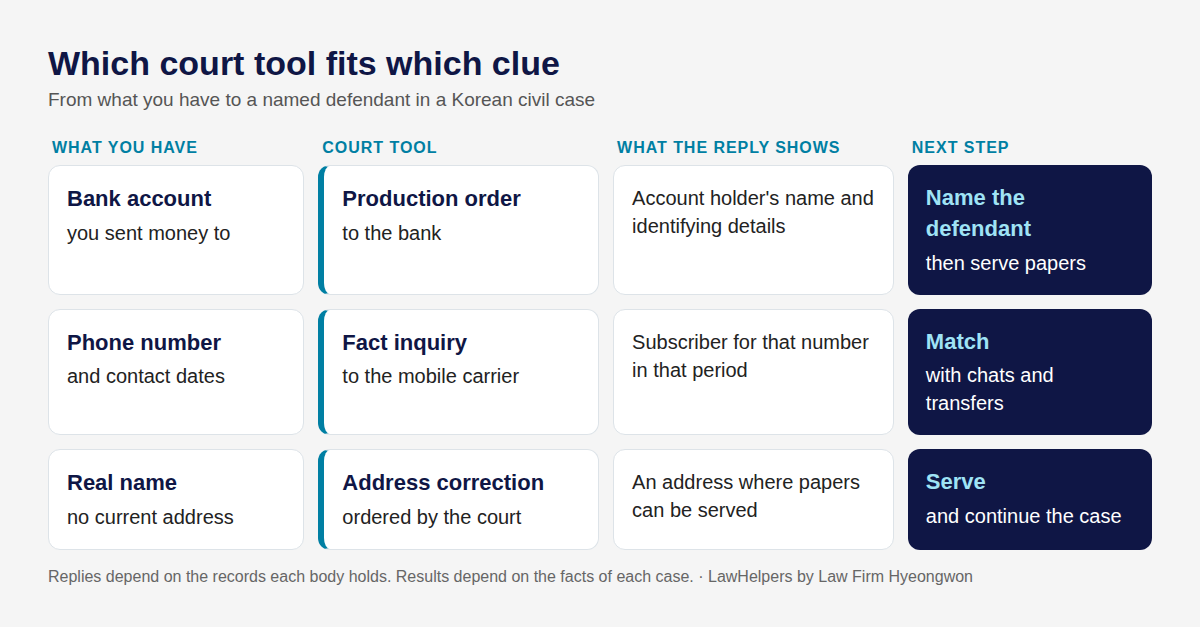
| What you have | Court tool to consider | What the reply can show | Limits |
|---|
| Bank account you sent money to, transfer receipt | Order to produce financial transaction information (Civil Procedure Act Art. 344, 347; Act on Real Name Financial Transactions Art. 4) | The account holder’s name and identifying details, within the scope the court allows | Shows who holds the account, not necessarily who asked for the money |
| Mobile phone number and the dates you were in contact | Fact inquiry to the mobile carrier (Civil Procedure Act Art. 294) | Subscriber details for that number during that period | Numbers registered in someone else’s name or reassigned numbers need extra checking |
| Real name and an old address or workplace | Address correction ordered by the court (Civil Procedure Act Art. 254, 255) | A current address for serving court papers | You must show it is the same person |
| A foreign national’s name and passport or alien registration details | Fact inquiry to the immigration office (Civil Procedure Act Art. 294) | Registered address in Korea and whether the person has left Korea | You need enough detail to identify the person |
| Messages, contracts, delivery records | Submitted as evidence | Why the money was paid: a loan, a sale or something else | Foreign-language messages need a Korean translation |
A fact inquiry is a request from the court to a public body, company or individual to report facts within its records (Civil Procedure Act Art. 294). An order to produce documents is a court decision requiring the holder of a document to submit it (Art. 347). Korean banks may not disclose account information freely, but the Act on Real Name Financial Transactions allows disclosure under a court order (Art. 4(1)1).
Step by step: from unknown person to named defendant
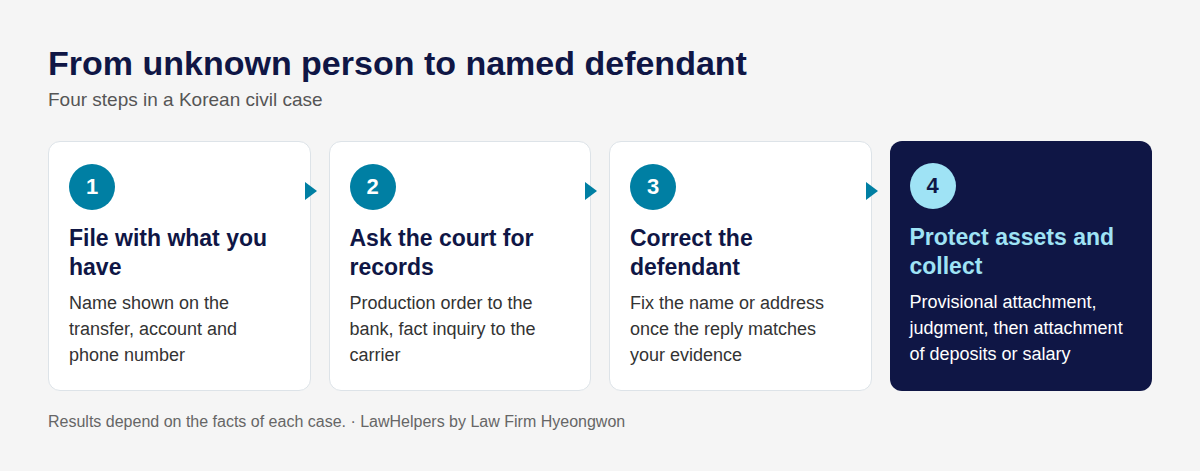
Step 1. File with the information you have
The complaint describes the defendant as precisely as your evidence allows, for example by the name shown on the transfer receipt together with the account number. If details are missing, the court will order you to complete them before the complaint can be served (Civil Procedure Act Art. 254, 255).
Step 2. Apply for the inquiry or production order
The application must explain why the information is needed: where you obtained the number or account, when you were in contact, and why the reply is necessary to identify the defendant. Specific, well-supported applications are more likely to be granted.
Step 3. Correct the defendant or the address
When the reply arrives, we compare it with the messages and transfer records. If the defendant’s name or details were recorded incorrectly, the description is corrected. If the wrong person was sued, a change of defendant can be requested before the first-instance hearings close, subject to conditions (Civil Procedure Act Art. 260).
Step 4. Protect assets, serve and continue to judgment
Once the defendant is identified, consider provisional attachment if assets may be moved. The papers are then served, and the case proceeds to judgment and, if needed, to attachment of bank deposits, salary or a lease deposit. See Provisional Attachment in Korea.
Payment order or lawsuit?
A payment order is faster and cheaper, but it is available only if the debtor can be served in Korea by a method other than service by publication (Civil Procedure Act Art. 462). If you do not know the address, or the person may have left Korea, a regular lawsuit is usually the better route. In a lawsuit, if service is still impossible after the inquiries, the court may allow service by publication, but the reasons must be shown (Art. 194). See Payment Orders in Korea.
If the other person is also a foreign national
1) Names: the name in Korean bank or carrier records may be a Korean transliteration of a foreign name, or the name as written in a passport. Keep every version of the name you have seen.
2) Leaving Korea: a person who has left Korea can still be sued, but service abroad takes longer and a payment order is not available. Act before they leave if you can.
3) Immigration records: the court can be asked to send a fact inquiry to the immigration office to confirm the person’s registered address in Korea and whether they have left the country (Art. 294). This is used in practice when a foreign defendant’s address is unknown.
A realistic view
1) A bank account in the person’s own name gives the best chance of identification.
2) A borrowed account, a phone number registered to someone else or an overseas messaging account may lead only to an intermediary. Further evidence, or information from a criminal investigation, may then be needed.
3) Identification does not mean payment. Recovery depends on whether the person has attachable assets in Korea, such as bank deposits, salary or a lease deposit.
We will tell you honestly which of these situations your case is in before you spend money on it.
What to prepare
1) Transfer records: receipts, bank name, account number, the holder name shown, dates and amounts
2) Contact details: phone numbers, KakaoTalk or other messenger IDs, profile screenshots and the dates you were in contact
3) The conversation: the request for money, any promise to repay or deliver, and the messages around the time contact stopped
4) Anything else you know: workplace, school, neighborhood, vehicle, social media accounts
5) A short timeline in English. We prepare the Korean translation of the key messages.
Frequently asked questions
Q. Can I sue someone in Korea without knowing their address?
A. Yes. You can file with the information you have, and the court can be asked to obtain the details needed to identify and serve the defendant.
Q. Will the bank tell me who owns the account if I ask?
A. No. Banks do not disclose account holder information to individuals. It is provided to the court under a court order during the case.
Q. I only have a phone number. Is that enough?
A. It can be a starting point. The carrier can be asked who subscribed to the number during the period you were in contact, but if the number was registered in someone else’s name, more evidence will be needed. Results are not guaranteed.
Q. What if the person only used KakaoTalk or Instagram?
A. A messenger or social media ID alone is usually a weak clue. Combine it with any bank account, phone number or real-world detail you have.
Q. Can I use a payment order if I do not know the address?
A. Usually not. A payment order requires service in Korea by a method other than service by publication (Civil Procedure Act Art. 462). A lawsuit is the safer route.
Q. The person has already left Korea. Is it too late?
A. Not necessarily. You can still sue, but service abroad takes time, and recovery depends on whether assets remain in Korea, such as bank deposits or a lease deposit.
Q. I live outside Korea now. Can a lawyer handle everything?
A. Yes. A Korean lawyer can file, apply for the inquiries and attend hearings under a power of attorney, and we communicate with you in English.
Related guides
• Romance Scam Victim in Korea: Identifying the Scammer and Recovering Your Money
• How to Find a Debtor’s Assets in Korea
• Payment Orders in Korea
Based on the Civil Procedure Act, the Civil Execution Act and the Act on Real Name Financial Transactions as of 2026. This guide provides general legal information and is not legal advice for any specific case. Results depend on the facts of each case.
Only have a name, a number or an account?
From identifying the other party through the court to provisional attachment, a lawsuit and enforcement, a Korean debt collection lawyer handles your case in English.
Request a consultation ➔







Summary You can start a civil case in Korea even if you do not know the other person’s address or resident registration number. If you have the bank account you sent money to, the phone number they used or your message history, a Korean court can be asked to obtain the information needed to identify them. This guide explains which court tool fits which clue, what the reply can and cannot tell you, and how the case moves from an unknown person to a named defendant and, finally, to collection.
Hello, I am Hyunwoo Shin, Managing Attorney at Law Firm Hyeongwon and a lawyer registered with the Korean Bar Association as a specialist in debt collection.
A common situation among our foreign clients: a former roommate who left without paying their share, a customer who stopped answering after delivery, a co-worker who borrowed money and changed jobs, or a seller on a second-hand app who never shipped. You know them by a first name, a nickname or an English name. You have a phone number, a KakaoTalk chat and a transfer receipt. You do not have an address.
This guide is about that problem: identifying who the other person legally is so that a Korean court can proceed against them. If you were the victim of an online romance or investment scam, see Romance Scam Victim in Korea. If you already know who the debtor is and need to find their assets, see How to Find a Debtor’s Assets in Korea. This guide reflects Korean law as of 2026.
Bottom line
1) Not knowing an address does not stop you from filing. Not knowing who the person is at all is a different and harder problem.
2) A bank account is usually the strongest clue. The court can order the bank to disclose the account holder.
3) A phone number can be checked with the mobile carrier through a fact inquiry, but the reply must be matched to the period you were in contact.
4) Identification is only the first step. Plan provisional attachment, the lawsuit and enforcement from the start.
Two different problems
1. You know who they are, but not where they live
You know their real name and can show that the person you dealt with is that person. What is missing is an address for serving court papers. This is mainly a service problem, and the court process can help you complete it.
2. You are not sure who they really are
They used a nickname, an English name you cannot match to Korean records, or a name that may be false. Here the first task is to show who should be the defendant at all. Every clue — the account holder name, the phone number, the messages and how the money moved — has to be compared so that the claim is directed at the right person.
Which court tool fits which clue
A fact inquiry is a request from the court to a public body, company or individual to report facts within its records (Civil Procedure Act Art. 294). An order to produce documents is a court decision requiring the holder of a document to submit it (Art. 347). Korean banks may not disclose account information freely, but the Act on Real Name Financial Transactions allows disclosure under a court order (Art. 4(1)1).
Step by step: from unknown person to named defendant
Step 1. File with the information you have
The complaint describes the defendant as precisely as your evidence allows, for example by the name shown on the transfer receipt together with the account number. If details are missing, the court will order you to complete them before the complaint can be served (Civil Procedure Act Art. 254, 255).
Step 2. Apply for the inquiry or production order
The application must explain why the information is needed: where you obtained the number or account, when you were in contact, and why the reply is necessary to identify the defendant. Specific, well-supported applications are more likely to be granted.
Step 3. Correct the defendant or the address
When the reply arrives, we compare it with the messages and transfer records. If the defendant’s name or details were recorded incorrectly, the description is corrected. If the wrong person was sued, a change of defendant can be requested before the first-instance hearings close, subject to conditions (Civil Procedure Act Art. 260).
Step 4. Protect assets, serve and continue to judgment
Once the defendant is identified, consider provisional attachment if assets may be moved. The papers are then served, and the case proceeds to judgment and, if needed, to attachment of bank deposits, salary or a lease deposit. See Provisional Attachment in Korea.
Payment order or lawsuit?
A payment order is faster and cheaper, but it is available only if the debtor can be served in Korea by a method other than service by publication (Civil Procedure Act Art. 462). If you do not know the address, or the person may have left Korea, a regular lawsuit is usually the better route. In a lawsuit, if service is still impossible after the inquiries, the court may allow service by publication, but the reasons must be shown (Art. 194). See Payment Orders in Korea.
If the other person is also a foreign national
1) Names: the name in Korean bank or carrier records may be a Korean transliteration of a foreign name, or the name as written in a passport. Keep every version of the name you have seen.
2) Leaving Korea: a person who has left Korea can still be sued, but service abroad takes longer and a payment order is not available. Act before they leave if you can.
3) Immigration records: the court can be asked to send a fact inquiry to the immigration office to confirm the person’s registered address in Korea and whether they have left the country (Art. 294). This is used in practice when a foreign defendant’s address is unknown.
A realistic view
1) A bank account in the person’s own name gives the best chance of identification.
2) A borrowed account, a phone number registered to someone else or an overseas messaging account may lead only to an intermediary. Further evidence, or information from a criminal investigation, may then be needed.
3) Identification does not mean payment. Recovery depends on whether the person has attachable assets in Korea, such as bank deposits, salary or a lease deposit.
We will tell you honestly which of these situations your case is in before you spend money on it.
What to prepare
1) Transfer records: receipts, bank name, account number, the holder name shown, dates and amounts
2) Contact details: phone numbers, KakaoTalk or other messenger IDs, profile screenshots and the dates you were in contact
3) The conversation: the request for money, any promise to repay or deliver, and the messages around the time contact stopped
4) Anything else you know: workplace, school, neighborhood, vehicle, social media accounts
5) A short timeline in English. We prepare the Korean translation of the key messages.
Frequently asked questions
Q. Can I sue someone in Korea without knowing their address?
A. Yes. You can file with the information you have, and the court can be asked to obtain the details needed to identify and serve the defendant.
Q. Will the bank tell me who owns the account if I ask?
A. No. Banks do not disclose account holder information to individuals. It is provided to the court under a court order during the case.
Q. I only have a phone number. Is that enough?
A. It can be a starting point. The carrier can be asked who subscribed to the number during the period you were in contact, but if the number was registered in someone else’s name, more evidence will be needed. Results are not guaranteed.
Q. What if the person only used KakaoTalk or Instagram?
A. A messenger or social media ID alone is usually a weak clue. Combine it with any bank account, phone number or real-world detail you have.
Q. Can I use a payment order if I do not know the address?
A. Usually not. A payment order requires service in Korea by a method other than service by publication (Civil Procedure Act Art. 462). A lawsuit is the safer route.
Q. The person has already left Korea. Is it too late?
A. Not necessarily. You can still sue, but service abroad takes time, and recovery depends on whether assets remain in Korea, such as bank deposits or a lease deposit.
Q. I live outside Korea now. Can a lawyer handle everything?
A. Yes. A Korean lawyer can file, apply for the inquiries and attend hearings under a power of attorney, and we communicate with you in English.
Related guides
• Romance Scam Victim in Korea: Identifying the Scammer and Recovering Your Money
• How to Find a Debtor’s Assets in Korea
• Payment Orders in Korea
Based on the Civil Procedure Act, the Civil Execution Act and the Act on Real Name Financial Transactions as of 2026. This guide provides general legal information and is not legal advice for any specific case. Results depend on the facts of each case.
Only have a name, a number or an account?
From identifying the other party through the court to provisional attachment, a lawsuit and enforcement, a Korean debt collection lawyer handles your case in English.
Request a consultation ➔