Summary: If someone owes you 30 million KRW (about USD 22,000) or less in Korea, you do not need a long lawsuit to collect it. Korea's "small claims" procedure lets you file a simple claim, and if the other side does not object within two weeks of being notified, the court's recommendation to pay becomes as enforceable as a judgment — often without ever going to a hearing. This guide explains who qualifies, how the process works step by step, how long it realistically takes, and what foreign residents and overseas claimants often get wrong.

Who Can Use the Small Claims Procedure?
A case qualifies as a "small claim" (소액사건) if, at the time you file, you are asking for 30 million KRW or less in money — unpaid loans, unpaid invoices for goods or services, or a rental deposit a landlord is withholding are the most common examples.
One rule trips people up: you cannot split a larger claim into smaller pieces just to qualify. If you are actually owed 50 million KRW and only file for 30 million "to stay under the limit," the court can dismiss the case outright.
Source: Act on Special Cases Concerning Expedited Litigation Procedure for Small Claims ("Small Claims Act"), Art. 2; Small Claims Rules, Art. 1-2; Small Claims Act, Art. 5-2.
How the Process Works, Step by Step
| Step | What happens | Legal basis |
|---|
| 1 | You file a complaint (in person or in writing) | Small Claims Act, Art. 4 |
| 2 | The court serves the defendant with a Payment Recommendation Order | Art. 5-3 |
| 3 | If the defendant does not object within 2 weeks of service, the order becomes as enforceable as a final judgment | Art. 5-4, 5-7 |
| 4 | If the defendant does object, a hearing is scheduled — usually just one | Art. 5-4, Art. 7 |
| 5 | The court can rule immediately after the hearing closes | Art. 11-2 |
The Payment Recommendation Order (이행권고결정) is what makes this procedure fast. Instead of scheduling a hearing by default, the court reviews your complaint and, if it's in order, sends the other side an order to simply pay what you're asking for. If they don't formally object within two weeks of receiving it, that order carries the same legal weight as a court judgment — and you can generally move straight to enforcement with it, without a separate judgment or additional certification.
Source: Small Claims Act, Art. 5-3, 5-4(1), 5-7, 5-8(1).

How Long Does It Actually Take?
There's no fixed statutory deadline — it depends on how quickly the defendant is served and whether they contest the claim. But the procedure is built to move faster than ordinary litigation:
• If the defendant doesn't object, the case can end with the Payment Recommendation Order alone — no hearing at all.
• If they do object, the law directs the judge to resolve the matter in a single hearing wherever possible, and evidence can be requested even before that hearing.
• A ruling can be issued immediately after the hearing closes, without waiting for a separate judgment date.
Source: Small Claims Act, Art. 7(2)-(3), Art. 11-2(1).
The most common thing that slows a small claim down is service of process — getting the paperwork to the defendant. If you don't have a reliable address and the court has to resort to public notice service (공시송달), the Payment Recommendation Order process is skipped entirely and the case goes straight to a hearing.
Source: Small Claims Act, Art. 5-3(3)-(4).
What Foreign Residents and Overseas Claimants Often Miss
Small claims procedure is designed to be usable without a lawyer, and close family members (spouse, lineal relatives, siblings) can even represent you in court without special court permission. But in practice, these are the issues that most often catch foreign residents and claimants living outside Korea off guard:
• You can file even if you've left Korea. Having returned to your home country does not bar you from pursuing a claim for money owed to you in Korea — but you will need a reliable Korean mailing address or contact method for the court and the other side, since the whole fast-track process depends on service actually reaching the defendant (or you).
• A Korean-residing defendant who can't be reliably served will slow things down. If the other party has no fixed address in Korea, cannot be located, or has also left the country, the court may have to use public notice service — which skips the Payment Recommendation Order and sends the case straight to a hearing (see above).
• Evidence in English is usable, but plan for translation. Loan agreements, invoices, or chat logs in English can support your claim, but the court works in Korean, so be prepared to have key documents translated for submission and for the hearing if one is held.
• Interpretation at a hearing. If a hearing is held and your Korean isn't sufficient to follow it, you can arrange for interpretation — this is worth sorting out before the hearing date, not on the day.
• A family member can represent you, but only with proof. If a spouse, parent, child, or sibling will appear for you under the no-permission-needed rule, they'll need to show documentation of the family relationship and a power of attorney — plan for this in advance, especially if family documents need to be apostilled or translated. A close friend or acquaintance, however fluent in Korean, does not qualify under this rule and cannot act as your representative without the court's separate permission.
Source: Small Claims Act, Art. 8(1) (family representation).
Small Claims vs. a Payment Order — Which Should You Use?
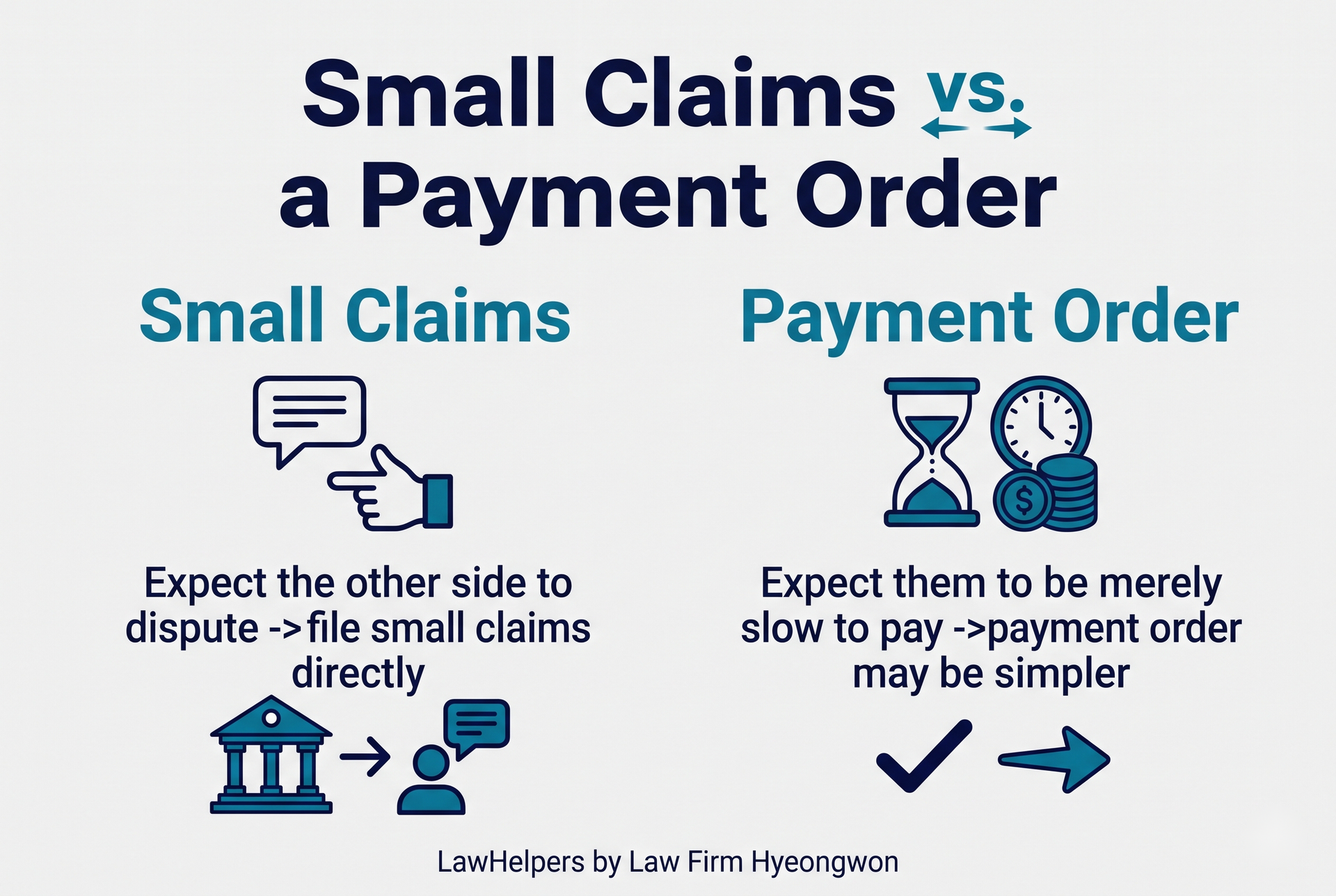
If the amount is 30 million KRW or less, a payment order (지급명령) is another fast option worth comparing. The key difference: if the other side formally objects to a payment order, the case converts into an ordinary lawsuit — and once a case has converted from a payment-order track into litigation this way, it is no longer eligible for a Payment Recommendation Order.
Source: Small Claims Act, Art. 5-3(1)(i).
As a rough guide: if you expect the other side to dispute the claim, filing a small claim from the start may be the more direct path. If they're likely to simply be slow to pay rather than deny owing the money, a payment order can be the simpler route. Which fits better depends on your evidence and how you expect the other side to respond — this is exactly the kind of judgment call worth getting a second opinion on before you file.
Example (Hypothetical)
A, who had lent 8 million KRW to an acquaintance, B, filed a small claim after B stopped responding once the agreed repayment date passed. A attached bank transfer records and a KakaoTalk message where B had written "I'll pay you back next month." The court sent B a Payment Recommendation Order. B did not object within two weeks, so the order became final — and A used the certified copy of that order to apply for attachment and collection against B's bank deposits, without a separate judgment.
This is a hypothetical example for illustration, not an account of an actual case. Source: Small Claims Act, Art. 5-4, 5-7, 5-8.
The Process in 5 Steps
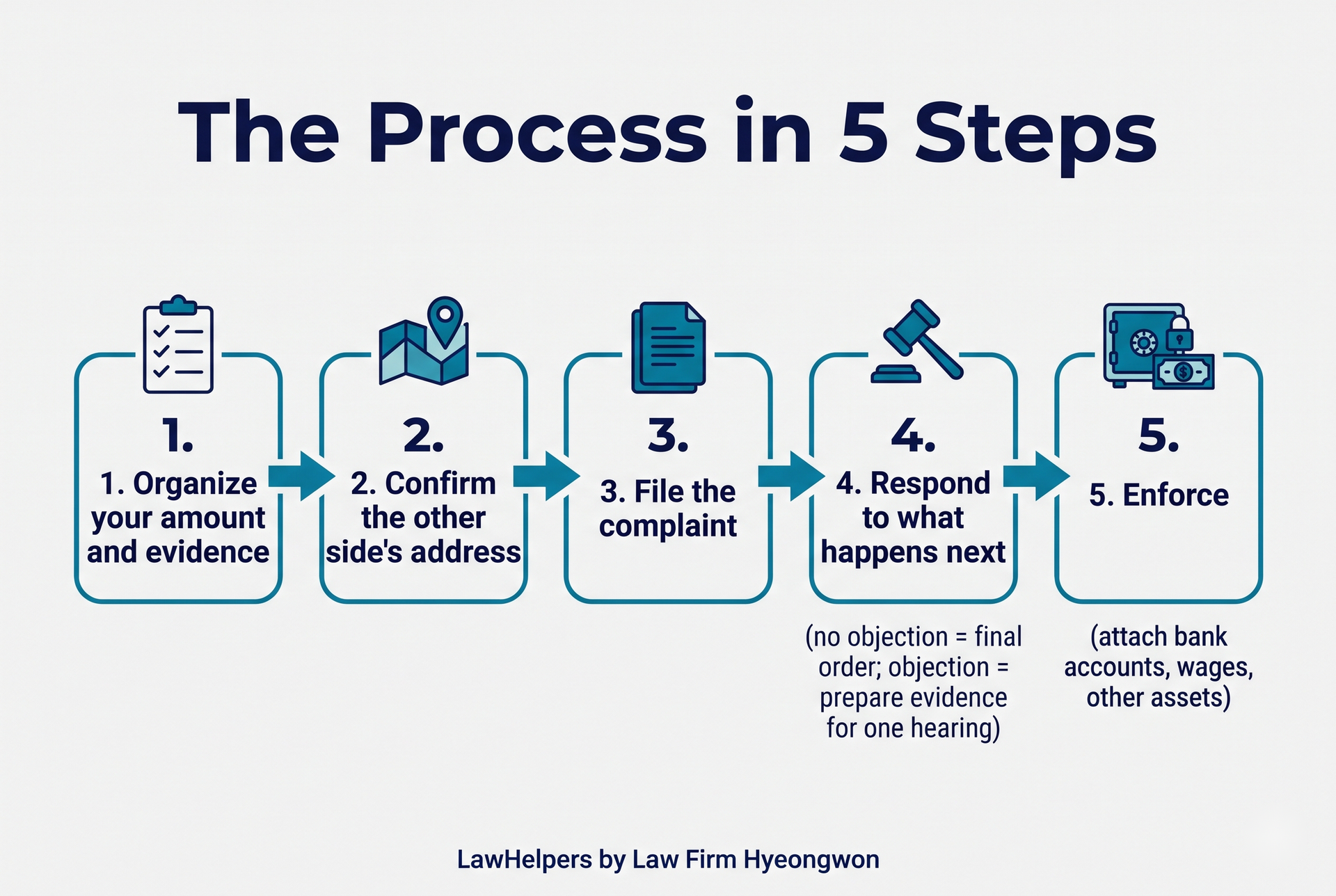
1) Organize your amount and evidence — confirm your claim is 30 million KRW or less, and gather loan documents, transfer records, and message logs.
2) Confirm the other side's address — the Payment Recommendation Order can't reach them without one.
3) File the complaint — in writing, or in person at the competent court.
4) Respond to what happens next — if there's no objection within 2 weeks, the order becomes final; if there is, prepare all your evidence for a single hearing.
5) Enforce — use the finalized order or judgment to attach the other side's bank accounts, wages, or other assets in Korea.
Source: Small Claims Act, Art. 4, 5-3, 5-4, 5-7, 5-8, 7.
FAQ
Q. My claim is a bit over 30 million KRW — can I just claim 30 million and file the rest later?
A. No. Splitting a claim to stay under the small-claims threshold is not allowed, and a case filed this way can be dismissed. (Small Claims Act, Art. 5-2)
Q. Is a Payment Recommendation Order guaranteed in every small claim?
A. No. Cases that have converted over from a payment-order procedure, or where the claim itself is unclear, may skip straight to a hearing instead. (Art. 5-3(1))
Q. Can a family member appear in court for me instead of a lawyer?
A. Yes — a spouse, lineal relative, or sibling can act as your representative without needing the court's permission, as long as they can prove the relationship and present a power of attorney. (Art. 8)
Q. If the Payment Recommendation Order becomes final, can I go straight to seizing assets?
A. Generally yes — a certified copy of the finalized order can be used for enforcement without obtaining a separate writ of execution, though there are exceptions for cases involving a successor. (Art. 5-8)
Q. I lost and don't understand why — the judgment barely explains the reasoning. What can I do?
A. Small claims judgments can omit detailed reasoning, which is intentional. You can still appeal within 2 weeks of being served the judgment — it helps to have noted the judge's stated reasoning at the hearing itself. (Art. 11-2(3), Civil Procedure Act Art. 396)
Related Guides
• Payment Orders in Korea
• Provisional Attachment in Korea
• Won a Judgment in Korea but Still Not Paid? How to Enforce a Korean Court Judgment
Sources & Disclaimer
Based on the Act on Special Cases Concerning Expedited Litigation Procedure for Small Claims (Arts. 2, 3, 4, 5, 5-2 through 5-8, 7-11-2), the Small Claims Rules (Art. 1-2), and the Civil Procedure Act (Art. 396). This guide is general legal information, not legal advice for your specific situation. Results depend on the facts of each case.
Contact Us
LawHelpers by Law Firm Hyeongwon helps foreign residents in Korea recover unpaid money through payment orders, small claims, and enforcement. Attorney Hyunwoo Shin is registered with the Korean Bar Association as a debt collection specialist.
Contact us today by email (law.shin@lawhelpers.co.kr), KakaoTalk or WhatsApp — links on our website.
Results depend on the facts of each case. Advertising lawyer: Hyunwoo Shin








Summary: If someone owes you 30 million KRW (about USD 22,000) or less in Korea, you do not need a long lawsuit to collect it. Korea's "small claims" procedure lets you file a simple claim, and if the other side does not object within two weeks of being notified, the court's recommendation to pay becomes as enforceable as a judgment — often without ever going to a hearing. This guide explains who qualifies, how the process works step by step, how long it realistically takes, and what foreign residents and overseas claimants often get wrong.
Who Can Use the Small Claims Procedure?
A case qualifies as a "small claim" (소액사건) if, at the time you file, you are asking for 30 million KRW or less in money — unpaid loans, unpaid invoices for goods or services, or a rental deposit a landlord is withholding are the most common examples.
One rule trips people up: you cannot split a larger claim into smaller pieces just to qualify. If you are actually owed 50 million KRW and only file for 30 million "to stay under the limit," the court can dismiss the case outright.
Source: Act on Special Cases Concerning Expedited Litigation Procedure for Small Claims ("Small Claims Act"), Art. 2; Small Claims Rules, Art. 1-2; Small Claims Act, Art. 5-2.
How the Process Works, Step by Step
The Payment Recommendation Order (이행권고결정) is what makes this procedure fast. Instead of scheduling a hearing by default, the court reviews your complaint and, if it's in order, sends the other side an order to simply pay what you're asking for. If they don't formally object within two weeks of receiving it, that order carries the same legal weight as a court judgment — and you can generally move straight to enforcement with it, without a separate judgment or additional certification.
Source: Small Claims Act, Art. 5-3, 5-4(1), 5-7, 5-8(1).
How Long Does It Actually Take?
There's no fixed statutory deadline — it depends on how quickly the defendant is served and whether they contest the claim. But the procedure is built to move faster than ordinary litigation:
• If the defendant doesn't object, the case can end with the Payment Recommendation Order alone — no hearing at all.
• If they do object, the law directs the judge to resolve the matter in a single hearing wherever possible, and evidence can be requested even before that hearing.
• A ruling can be issued immediately after the hearing closes, without waiting for a separate judgment date.
Source: Small Claims Act, Art. 7(2)-(3), Art. 11-2(1).
The most common thing that slows a small claim down is service of process — getting the paperwork to the defendant. If you don't have a reliable address and the court has to resort to public notice service (공시송달), the Payment Recommendation Order process is skipped entirely and the case goes straight to a hearing.
Source: Small Claims Act, Art. 5-3(3)-(4).
What Foreign Residents and Overseas Claimants Often Miss
Small claims procedure is designed to be usable without a lawyer, and close family members (spouse, lineal relatives, siblings) can even represent you in court without special court permission. But in practice, these are the issues that most often catch foreign residents and claimants living outside Korea off guard:
• You can file even if you've left Korea. Having returned to your home country does not bar you from pursuing a claim for money owed to you in Korea — but you will need a reliable Korean mailing address or contact method for the court and the other side, since the whole fast-track process depends on service actually reaching the defendant (or you).
• A Korean-residing defendant who can't be reliably served will slow things down. If the other party has no fixed address in Korea, cannot be located, or has also left the country, the court may have to use public notice service — which skips the Payment Recommendation Order and sends the case straight to a hearing (see above).
• Evidence in English is usable, but plan for translation. Loan agreements, invoices, or chat logs in English can support your claim, but the court works in Korean, so be prepared to have key documents translated for submission and for the hearing if one is held.
• Interpretation at a hearing. If a hearing is held and your Korean isn't sufficient to follow it, you can arrange for interpretation — this is worth sorting out before the hearing date, not on the day.
• A family member can represent you, but only with proof. If a spouse, parent, child, or sibling will appear for you under the no-permission-needed rule, they'll need to show documentation of the family relationship and a power of attorney — plan for this in advance, especially if family documents need to be apostilled or translated. A close friend or acquaintance, however fluent in Korean, does not qualify under this rule and cannot act as your representative without the court's separate permission.
Source: Small Claims Act, Art. 8(1) (family representation).
Small Claims vs. a Payment Order — Which Should You Use?
If the amount is 30 million KRW or less, a payment order (지급명령) is another fast option worth comparing. The key difference: if the other side formally objects to a payment order, the case converts into an ordinary lawsuit — and once a case has converted from a payment-order track into litigation this way, it is no longer eligible for a Payment Recommendation Order.
Source: Small Claims Act, Art. 5-3(1)(i).
As a rough guide: if you expect the other side to dispute the claim, filing a small claim from the start may be the more direct path. If they're likely to simply be slow to pay rather than deny owing the money, a payment order can be the simpler route. Which fits better depends on your evidence and how you expect the other side to respond — this is exactly the kind of judgment call worth getting a second opinion on before you file.
Example (Hypothetical)
A, who had lent 8 million KRW to an acquaintance, B, filed a small claim after B stopped responding once the agreed repayment date passed. A attached bank transfer records and a KakaoTalk message where B had written "I'll pay you back next month." The court sent B a Payment Recommendation Order. B did not object within two weeks, so the order became final — and A used the certified copy of that order to apply for attachment and collection against B's bank deposits, without a separate judgment.
This is a hypothetical example for illustration, not an account of an actual case. Source: Small Claims Act, Art. 5-4, 5-7, 5-8.
The Process in 5 Steps
1) Organize your amount and evidence — confirm your claim is 30 million KRW or less, and gather loan documents, transfer records, and message logs.
2) Confirm the other side's address — the Payment Recommendation Order can't reach them without one.
3) File the complaint — in writing, or in person at the competent court.
4) Respond to what happens next — if there's no objection within 2 weeks, the order becomes final; if there is, prepare all your evidence for a single hearing.
5) Enforce — use the finalized order or judgment to attach the other side's bank accounts, wages, or other assets in Korea.
Source: Small Claims Act, Art. 4, 5-3, 5-4, 5-7, 5-8, 7.
FAQ
Q. My claim is a bit over 30 million KRW — can I just claim 30 million and file the rest later?
A. No. Splitting a claim to stay under the small-claims threshold is not allowed, and a case filed this way can be dismissed. (Small Claims Act, Art. 5-2)
Q. Is a Payment Recommendation Order guaranteed in every small claim?
A. No. Cases that have converted over from a payment-order procedure, or where the claim itself is unclear, may skip straight to a hearing instead. (Art. 5-3(1))
Q. Can a family member appear in court for me instead of a lawyer?
A. Yes — a spouse, lineal relative, or sibling can act as your representative without needing the court's permission, as long as they can prove the relationship and present a power of attorney. (Art. 8)
Q. If the Payment Recommendation Order becomes final, can I go straight to seizing assets?
A. Generally yes — a certified copy of the finalized order can be used for enforcement without obtaining a separate writ of execution, though there are exceptions for cases involving a successor. (Art. 5-8)
Q. I lost and don't understand why — the judgment barely explains the reasoning. What can I do?
A. Small claims judgments can omit detailed reasoning, which is intentional. You can still appeal within 2 weeks of being served the judgment — it helps to have noted the judge's stated reasoning at the hearing itself. (Art. 11-2(3), Civil Procedure Act Art. 396)
Related Guides
• Payment Orders in Korea
• Provisional Attachment in Korea
• Won a Judgment in Korea but Still Not Paid? How to Enforce a Korean Court Judgment
Sources & Disclaimer
Based on the Act on Special Cases Concerning Expedited Litigation Procedure for Small Claims (Arts. 2, 3, 4, 5, 5-2 through 5-8, 7-11-2), the Small Claims Rules (Art. 1-2), and the Civil Procedure Act (Art. 396). This guide is general legal information, not legal advice for your specific situation. Results depend on the facts of each case.
Contact Us
LawHelpers by Law Firm Hyeongwon helps foreign residents in Korea recover unpaid money through payment orders, small claims, and enforcement. Attorney Hyunwoo Shin is registered with the Korean Bar Association as a debt collection specialist.
Contact us today by email (law.shin@lawhelpers.co.kr), KakaoTalk or WhatsApp — links on our website.
Results depend on the facts of each case. Advertising lawyer: Hyunwoo Shin