Fraudulent Conveyance in Korea: Reversing an Asset Transfer to a Family Member and the 1-Year/5-Year Deadline
Summary: If a debtor who doesn't have enough assets to pay you transfers property — a house, land, or other asset — to a family member, or sells it off at an unusually low price, Korean law lets you undo that transaction. This is called a "fraudulent conveyance" claim (사해행위취소), and if you win, the transferred property can be restored to the debtor's name so you can enforce against it. This guide explains when a transfer counts as fraudulent, the strict 1-year/5-year deadline to file, and what creditors living outside Korea often get wrong when the debtor's family has moved assets out of reach.

What Is a Fraudulent Conveyance Claim?
A "fraudulent act" (사해행위) is any act by which a debtor — knowing it will harm their creditors — reduces their own assets. Korean law lets a creditor ask the court to revoke that act and restore the property to its original state.
There's an important limit: if the person who received the property (the beneficiary) — or someone who later received it from the beneficiary (a sub-acquirer) — did not know, at the time, that the transfer would harm creditors, the transfer cannot be revoked.
Source: Civil Act, Art. 406(1).
Revocation and restitution don't just benefit the one creditor who sued — they benefit all of the debtor's creditors. Once the property is returned, it becomes the debtor's property again, and any other creditor can also seek to collect from it.
Source: Civil Act, Art. 407.
When Does a Transfer Count as a Fraudulent Act?
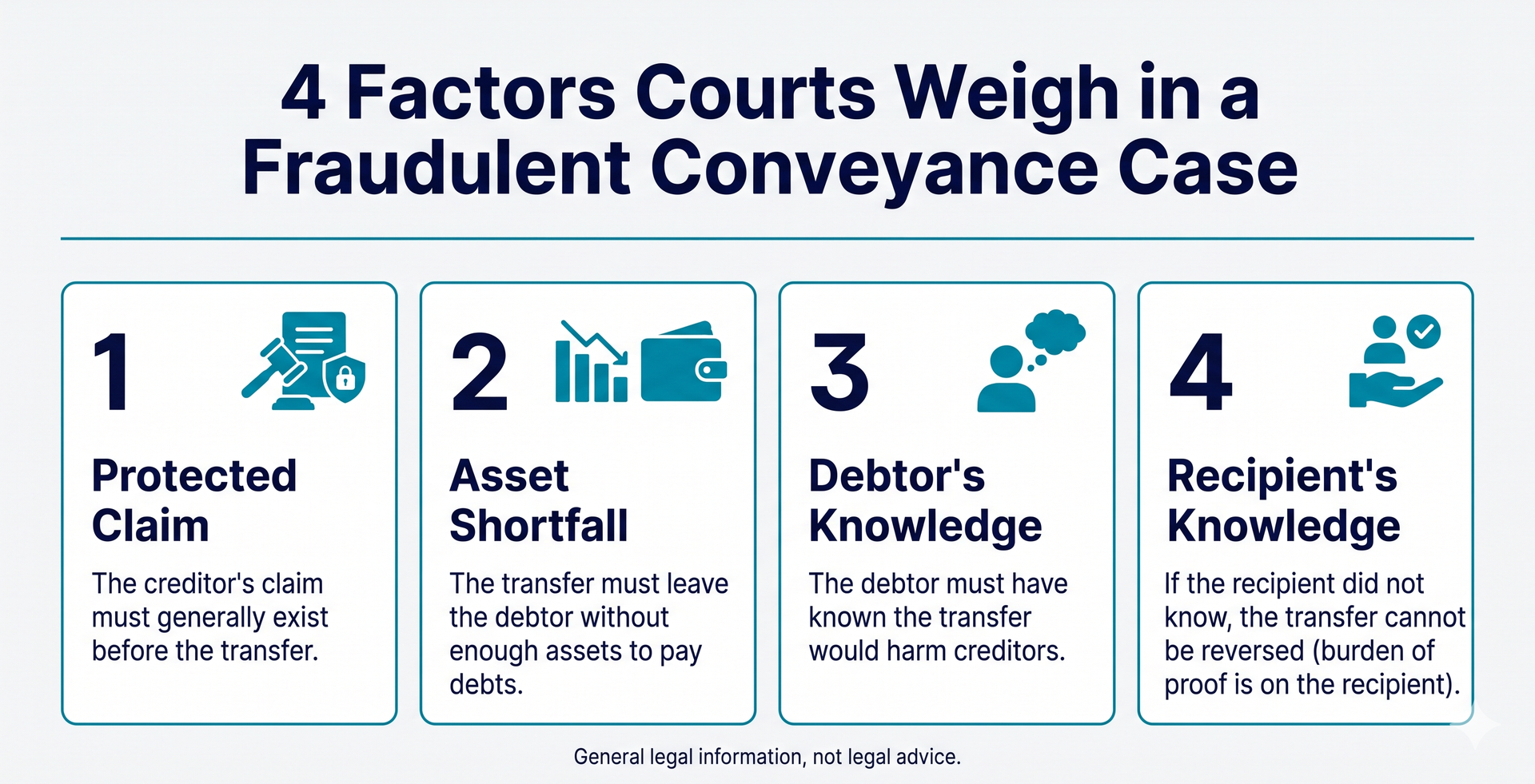
Courts generally weigh four factors:
| Factor | What it means |
|---|
| Protected claim | In principle, your claim against the debtor must have existed before the transfer |
| Asset shortfall | The transfer must leave the debtor without enough assets to cover debts (or make an existing shortfall worse) |
| Debtor's knowledge | The debtor must have known the transfer would harm creditors |
| Recipient's knowledge | If the recipient didn't know, the transfer can't be revoked — and it's the recipient who must prove they didn't know |
Source: Civil Act, Art. 406(1); Supreme Court 2001.3.23. 2000Da37821; Supreme Court 2006.7.4. 2004Da61280.
There's a narrow exception for claims that technically arose after the transfer: if the underlying legal relationship already existed at the time of the transfer, it was highly likely a claim would soon arise from it, and a claim did in fact arise that way, the claim can still be protected.
Source: Supreme Court 2001.3.23. 2000Da37821.
Which Transactions Are Most Often at Issue?
| Transaction | How courts tend to view it |
|---|
| Gift to a spouse or child | Likely fraudulent if the debtor's remaining assets are insufficient |
| Selling the debtor's only piece of real estate | Fraudulent even if a fair price was paid, absent special circumstances |
| Property division in a divorce | Only the portion that goes beyond a reasonable share is fraudulent |
| Transfer of mortgaged real estate | Only the value exceeding the secured (mortgage) debt is at issue |
Source: Supreme Court 1997.5.9. 96Da2606; Supreme Court 2000.9.29. 2000Da25569; Supreme Court 2001.6.12. 99Da20612.
"But They Paid Fair Value" — Can It Still Be Revoked?
Debtors often argue the transfer wasn't a gift — it was a legitimate sale. Korean courts have consistently rejected that defense in one specific situation: when a debtor sells their only real estate and converts it into cash (an asset that's much easier to spend or hide), that is treated as a fraudulent act absent special circumstances — and the debtor's knowledge of the harm to creditors is presumed.
Source: Supreme Court 1997.5.9. 96Da2606.
The debtor's "knowledge" here doesn't require any intent to actively harm the creditor — simply knowing that the transfer would leave insufficient assets to pay debts is enough.
Source: Supreme Court 1997.5.9. 96Da2606.
That said, if the proceeds from the sale were actually used to pay down debt, the outcome can change — so it's worth tracing where the sale proceeds actually went.
If the Family Member Says They Didn't Know About the Debt
It's common for the recipient to claim they had no idea the transfer would harm creditors. Korean courts place the burden of proving that on the recipient — and that proof has to be objective and credible, not just the debtor's say-so or a third party's guess.
Source: Supreme Court 2006.7.4. 2004Da61280.
Because this is decided case by case on the evidence, it helps to gather everything you can about the timing of the transfer, whether money actually changed hands, and whether the debtor kept living in the home after supposedly selling or gifting it.
How Are the 1-Year and 5-Year Deadlines Counted?
A fraudulent conveyance lawsuit must be filed within 1 year from when the creditor learned of the grounds for revocation, and in any case within 5 years from the date of the transaction. If either deadline passes, the claim is barred.
Source: Civil Act, Art. 406(2).
The 1-year clock doesn't start just because you learned the debtor transferred property. It starts when you learned the specific fraudulent act and that the debtor knew it would harm you — that is, the concrete facts of the fraudulent act plus the debtor's state of mind.
Source: Supreme Court 2006.7.4. 2004Da61280.
There's one exception: if the transfer involved the debtor's only piece of real estate, and at the time you learned of that transfer you also already knew the debtor had no other assets, the court treats you as having already known the grounds for revocation at that point.
Source: Supreme Court 1997.5.9. 96Da2606.
So once you confirm that a debtor's property has changed hands, don't assume you have a full year to spare — it's safer to start preparing immediately.
In practice, missing this deadline is one reason a case doesn't move forward — but it's usually not the hardest part. What's actually harder is proving that the debtor diverted assets of real value in the first place: a transfer can look suspicious on paper but still be difficult to substantiate without solid supporting records. For that reason, we generally advise gathering as much corroborating material as possible — property and transaction records, anything documenting where the debtor's assets actually went — alongside the broader debt-collection effort, rather than waiting until the point of filing to start assembling evidence.

What Foreign Residents and Overseas Creditors Often Get Wrong
A fraudulent conveyance claim works the same way regardless of your nationality or where you live — but these are the issues that most often catch foreign residents and creditors living outside Korea off guard:
- You can sue from outside Korea, but service has to actually reach the recipient. Whether you've returned to your home country or never lived in Korea at all doesn't bar you from filing. But the lawsuit has to be served on the person who received the property (not the debtor), and if that person can't be reliably located or served, the court may have to resort to public notice service — which slows the case down considerably.
- The 1-year/5-year clock runs whether or not you're in Korea. Living abroad is not an excuse the court will accept for missing the deadline. If you discover a debtor's only asset has been quietly transferred to a relative, treat that discovery as the start of your 1-year window and act immediately.
- The defendant is the recipient, not the debtor. This surprises many overseas creditors: you're not suing the person who owes you money — you're suing the family member (or other recipient) who received the asset. Getting their correct name, Korean resident registration or passport details, and address matters for service.
- Evidence in English works, but plan for translation. Loan documents, bank transfer records, or messages in English can support your claim, but anything you file with the Korean court typically needs a Korean translation.
- You'll generally need a Korean lawyer to file and litigate this. Unlike small claims, a fraudulent conveyance case is an ordinary civil lawsuit with real evidentiary and procedural complexity — and if you're abroad, you'll usually need a power of attorney authorizing Korean counsel to act for you, which may need to be notarized or apostilled depending on where you are.
- Winning the revocation lawsuit alone does not put money in your pocket. Even after the property is restored to the debtor's name, you still need an enforcement title (a judgment or payment order) on your underlying claim to actually seize and sell it — see the related guides below.
Example (Hypothetical)
Creditor A had lent 100 million KRW to Debtor B, whose only significant asset was an apartment. When A demanded repayment after the due date passed, B donated the apartment to his spouse and completed the registration transfer within a month. As soon as A confirmed this through the property registry, A filed for a provisional disposition against the spouse to freeze the apartment, then filed both a fraudulent conveyance lawsuit and a separate lawsuit on the underlying loan. If the donation is revoked, the apartment's registration reverts to B's name, and A can then apply to seize and auction it under the loan judgment — though any prior mortgage or other creditors' claims on the proceeds could reduce what A actually collects.
This is a hypothetical example for illustration, not an account of an actual case. Source: Civil Act, Art. 406, 407.
What About Property Divided in a Divorce?
Dividing property between spouses on divorce is meant to settle what the couple built together and support the other spouse going forward. So even if a heavily indebted spouse transfers property as part of a divorce settlement, that division is generally not a fraudulent act — unless the share given goes beyond what's reasonable.
Source: Supreme Court 2000.9.29. 2000Da25569.
Even where the share is excessive, only the portion beyond a reasonable amount can be revoked, and the creditor has to prove that excessiveness — which usually means looking at the length of the marriage, how the property was accumulated, and the timing of the divorce relative to when the debt arose.
Source: Supreme Court 2000.9.29. 2000Da25569; Civil Act, Art. 839-2.
What Do You Actually Get Back If You Win?
The default remedy is restoring the property itself — for real estate, that means canceling the transfer registration and putting it back in the debtor's name.
If the property had an existing mortgage that was later cancelled after the transfer, you can instead ask the court to revoke the transfer only up to the property's value minus the mortgage debt, and claim that amount as monetary compensation.
Source: Supreme Court 2001.6.12. 99Da20612.
If the recipient has already resold the property to someone who didn't know about the fraudulent circumstances, restoring the property itself is no longer possible — instead, you claim monetary compensation equal to its value from the original recipient.
Importantly, winning a fraudulent conveyance judgment by itself does not pay you directly. Once the property is back in the debtor's name, you still need to seize and auction it under a judgment, payment order, or other enforcement title on your underlying claim. That's why a fraudulent conveyance lawsuit is usually filed alongside — or shortly after — a separate lawsuit or payment order on the debt itself.
5 Steps to Reverse a Fraudulent Transfer
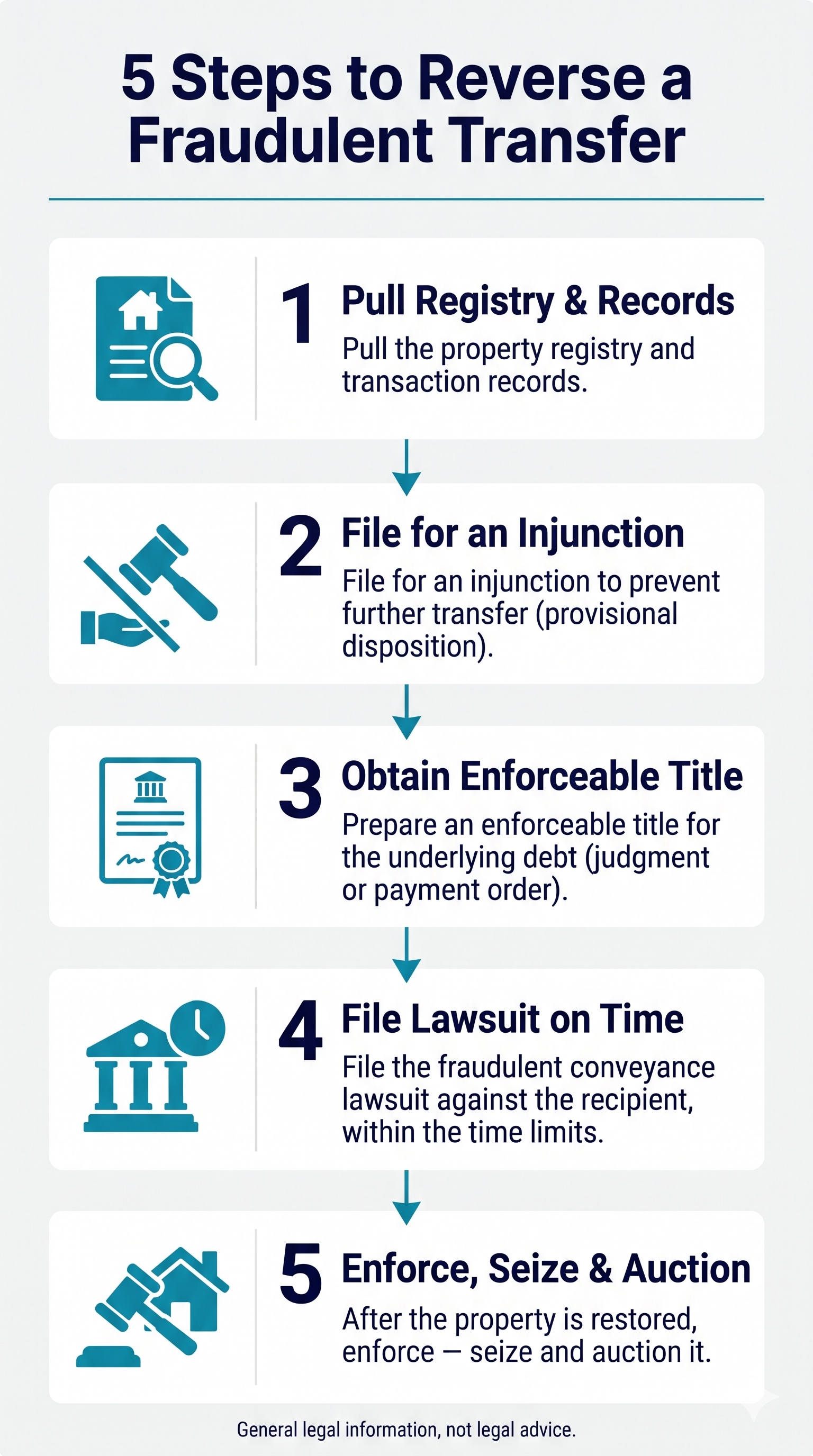
- Pull the registry and transaction records — get the property registration certificate and confirm when, to whom, and under what pretext (gift, sale, divorce division) the asset was transferred.
- File for an injunction (provisional disposition) — before the recipient can resell or encumber the property, freeze it with a provisional disposition prohibiting disposal.
- Obtain an enforceable title for the underlying debt — if you don't already have a judgment, pursue a loan lawsuit or payment order in parallel, and consider a provisional attachment against any remaining assets.
- File the fraudulent conveyance lawsuit on time — against the recipient, not the debtor, within the 1-year/5-year deadlines.
- Enforce, seize, and auction — once the registration is restored to the debtor's name, apply for a compulsory auction under your enforcement title and participate in the distribution of proceeds.
Source: Civil Act, Art. 406, 407; Civil Execution Act, Art. 300(1).
If a debtor has deliberately hidden or disposed of assets to evade your claim, a separate criminal complaint may also be worth considering alongside this civil process — that is covered in its own guide.
FAQ
Q. Can I file a fraudulent conveyance lawsuit before I even have a judgment against the debtor?
A. Yes. All you need is a valid, protectable claim against the debtor — you don't need a judgment on it first. That said, to actually collect once the property is restored, you'll need an enforcement title on the underlying claim, so many creditors pursue both at once.
Q. It's been 6 years since the debtor transferred the property. Is there anything I can do?
A. Once 5 years have passed since the transaction, a fraudulent conveyance lawsuit can no longer be filed (Civil Act, Art. 406(2)). You should check whether the property was transferred again afterward, or whether the debtor has any other remaining assets.
Q. If I win and the property is returned, do other creditors get to share in it too?
A. Yes. Revocation and restitution benefit all of the debtor's creditors (Civil Act, Art. 407), so when the restored property is auctioned, other creditors can also participate in the distribution — which is a good reason to move the enforcement process along quickly rather than waiting.
Q. The family member says they paid a fair price — does that block revocation?
A. Not necessarily. Korean Supreme Court precedent holds that selling a debtor's only real estate and converting it to cash is treated as a fraudulent act absent special circumstances, even if a fair price was paid (96Da2606). But if the sale proceeds were actually used to pay down debt, that can change the outcome — so the flow of the money matters.
Q. Can a property division from divorce be revoked too?
A. Only the portion that exceeds a reasonable division can be revoked, and the creditor has to prove that the division was excessive (2000Da25569).
Related Guides
Sources & Disclaimer
Based on the Civil Act (Arts. 406, 407, 839-2), the Civil Execution Act (Art. 300), and Supreme Court precedents including 1997.5.9. 96Da2606, 2000.9.29. 2000Da25569, 2001.3.23. 2000Da37821, 2001.6.12. 99Da20612, and 2006.7.4. 2004Da61280. This guide is general legal information, not legal advice for your specific situation. Results depend on the facts of each case.
Contact Us
LawHelpers by Law Firm Hyeongwon helps creditors in Korea — including foreign residents and overseas claimants — trace, freeze, and recover assets a debtor has transferred away. Debt-collection attorney Hyunwoo Shin is registered with the Korean Bar Association as a debt-collection specialist.
Contact us today by email (law.shin@lawhelpers.co.kr), KakaoTalk or WhatsApp — links on our website.
Results depend on the facts of each case. Advertising lawyer: Hyunwoo Shin








Fraudulent Conveyance in Korea: Reversing an Asset Transfer to a Family Member and the 1-Year/5-Year Deadline
What Is a Fraudulent Conveyance Claim?
A "fraudulent act" (사해행위) is any act by which a debtor — knowing it will harm their creditors — reduces their own assets. Korean law lets a creditor ask the court to revoke that act and restore the property to its original state.
There's an important limit: if the person who received the property (the beneficiary) — or someone who later received it from the beneficiary (a sub-acquirer) — did not know, at the time, that the transfer would harm creditors, the transfer cannot be revoked.
Source: Civil Act, Art. 406(1).
Revocation and restitution don't just benefit the one creditor who sued — they benefit all of the debtor's creditors. Once the property is returned, it becomes the debtor's property again, and any other creditor can also seek to collect from it.
Source: Civil Act, Art. 407.
When Does a Transfer Count as a Fraudulent Act?
Courts generally weigh four factors:
Source: Civil Act, Art. 406(1); Supreme Court 2001.3.23. 2000Da37821; Supreme Court 2006.7.4. 2004Da61280.
There's a narrow exception for claims that technically arose after the transfer: if the underlying legal relationship already existed at the time of the transfer, it was highly likely a claim would soon arise from it, and a claim did in fact arise that way, the claim can still be protected.
Source: Supreme Court 2001.3.23. 2000Da37821.
Which Transactions Are Most Often at Issue?
Source: Supreme Court 1997.5.9. 96Da2606; Supreme Court 2000.9.29. 2000Da25569; Supreme Court 2001.6.12. 99Da20612.
"But They Paid Fair Value" — Can It Still Be Revoked?
Debtors often argue the transfer wasn't a gift — it was a legitimate sale. Korean courts have consistently rejected that defense in one specific situation: when a debtor sells their only real estate and converts it into cash (an asset that's much easier to spend or hide), that is treated as a fraudulent act absent special circumstances — and the debtor's knowledge of the harm to creditors is presumed.
Source: Supreme Court 1997.5.9. 96Da2606.
The debtor's "knowledge" here doesn't require any intent to actively harm the creditor — simply knowing that the transfer would leave insufficient assets to pay debts is enough.
Source: Supreme Court 1997.5.9. 96Da2606.
That said, if the proceeds from the sale were actually used to pay down debt, the outcome can change — so it's worth tracing where the sale proceeds actually went.
If the Family Member Says They Didn't Know About the Debt
It's common for the recipient to claim they had no idea the transfer would harm creditors. Korean courts place the burden of proving that on the recipient — and that proof has to be objective and credible, not just the debtor's say-so or a third party's guess.
Source: Supreme Court 2006.7.4. 2004Da61280.
Because this is decided case by case on the evidence, it helps to gather everything you can about the timing of the transfer, whether money actually changed hands, and whether the debtor kept living in the home after supposedly selling or gifting it.
How Are the 1-Year and 5-Year Deadlines Counted?
A fraudulent conveyance lawsuit must be filed within 1 year from when the creditor learned of the grounds for revocation, and in any case within 5 years from the date of the transaction. If either deadline passes, the claim is barred.
Source: Civil Act, Art. 406(2).
The 1-year clock doesn't start just because you learned the debtor transferred property. It starts when you learned the specific fraudulent act and that the debtor knew it would harm you — that is, the concrete facts of the fraudulent act plus the debtor's state of mind.
Source: Supreme Court 2006.7.4. 2004Da61280.
There's one exception: if the transfer involved the debtor's only piece of real estate, and at the time you learned of that transfer you also already knew the debtor had no other assets, the court treats you as having already known the grounds for revocation at that point.
Source: Supreme Court 1997.5.9. 96Da2606.
So once you confirm that a debtor's property has changed hands, don't assume you have a full year to spare — it's safer to start preparing immediately.
In practice, missing this deadline is one reason a case doesn't move forward — but it's usually not the hardest part. What's actually harder is proving that the debtor diverted assets of real value in the first place: a transfer can look suspicious on paper but still be difficult to substantiate without solid supporting records. For that reason, we generally advise gathering as much corroborating material as possible — property and transaction records, anything documenting where the debtor's assets actually went — alongside the broader debt-collection effort, rather than waiting until the point of filing to start assembling evidence.
What Foreign Residents and Overseas Creditors Often Get Wrong
A fraudulent conveyance claim works the same way regardless of your nationality or where you live — but these are the issues that most often catch foreign residents and creditors living outside Korea off guard:
Example (Hypothetical)
Creditor A had lent 100 million KRW to Debtor B, whose only significant asset was an apartment. When A demanded repayment after the due date passed, B donated the apartment to his spouse and completed the registration transfer within a month. As soon as A confirmed this through the property registry, A filed for a provisional disposition against the spouse to freeze the apartment, then filed both a fraudulent conveyance lawsuit and a separate lawsuit on the underlying loan. If the donation is revoked, the apartment's registration reverts to B's name, and A can then apply to seize and auction it under the loan judgment — though any prior mortgage or other creditors' claims on the proceeds could reduce what A actually collects.
This is a hypothetical example for illustration, not an account of an actual case. Source: Civil Act, Art. 406, 407.
What About Property Divided in a Divorce?
Dividing property between spouses on divorce is meant to settle what the couple built together and support the other spouse going forward. So even if a heavily indebted spouse transfers property as part of a divorce settlement, that division is generally not a fraudulent act — unless the share given goes beyond what's reasonable.
Source: Supreme Court 2000.9.29. 2000Da25569.
Even where the share is excessive, only the portion beyond a reasonable amount can be revoked, and the creditor has to prove that excessiveness — which usually means looking at the length of the marriage, how the property was accumulated, and the timing of the divorce relative to when the debt arose.
Source: Supreme Court 2000.9.29. 2000Da25569; Civil Act, Art. 839-2.
What Do You Actually Get Back If You Win?
The default remedy is restoring the property itself — for real estate, that means canceling the transfer registration and putting it back in the debtor's name.
If the property had an existing mortgage that was later cancelled after the transfer, you can instead ask the court to revoke the transfer only up to the property's value minus the mortgage debt, and claim that amount as monetary compensation.
Source: Supreme Court 2001.6.12. 99Da20612.
If the recipient has already resold the property to someone who didn't know about the fraudulent circumstances, restoring the property itself is no longer possible — instead, you claim monetary compensation equal to its value from the original recipient.
Importantly, winning a fraudulent conveyance judgment by itself does not pay you directly. Once the property is back in the debtor's name, you still need to seize and auction it under a judgment, payment order, or other enforcement title on your underlying claim. That's why a fraudulent conveyance lawsuit is usually filed alongside — or shortly after — a separate lawsuit or payment order on the debt itself.
5 Steps to Reverse a Fraudulent Transfer
Source: Civil Act, Art. 406, 407; Civil Execution Act, Art. 300(1).
If a debtor has deliberately hidden or disposed of assets to evade your claim, a separate criminal complaint may also be worth considering alongside this civil process — that is covered in its own guide.
FAQ
Q. Can I file a fraudulent conveyance lawsuit before I even have a judgment against the debtor?
A. Yes. All you need is a valid, protectable claim against the debtor — you don't need a judgment on it first. That said, to actually collect once the property is restored, you'll need an enforcement title on the underlying claim, so many creditors pursue both at once.
Q. It's been 6 years since the debtor transferred the property. Is there anything I can do?
A. Once 5 years have passed since the transaction, a fraudulent conveyance lawsuit can no longer be filed (Civil Act, Art. 406(2)). You should check whether the property was transferred again afterward, or whether the debtor has any other remaining assets.
Q. If I win and the property is returned, do other creditors get to share in it too?
A. Yes. Revocation and restitution benefit all of the debtor's creditors (Civil Act, Art. 407), so when the restored property is auctioned, other creditors can also participate in the distribution — which is a good reason to move the enforcement process along quickly rather than waiting.
Q. The family member says they paid a fair price — does that block revocation?
A. Not necessarily. Korean Supreme Court precedent holds that selling a debtor's only real estate and converting it to cash is treated as a fraudulent act absent special circumstances, even if a fair price was paid (96Da2606). But if the sale proceeds were actually used to pay down debt, that can change the outcome — so the flow of the money matters.
Q. Can a property division from divorce be revoked too?
A. Only the portion that exceeds a reasonable division can be revoked, and the creditor has to prove that the division was excessive (2000Da25569).
Related Guides
Sources & Disclaimer
Based on the Civil Act (Arts. 406, 407, 839-2), the Civil Execution Act (Art. 300), and Supreme Court precedents including 1997.5.9. 96Da2606, 2000.9.29. 2000Da25569, 2001.3.23. 2000Da37821, 2001.6.12. 99Da20612, and 2006.7.4. 2004Da61280. This guide is general legal information, not legal advice for your specific situation. Results depend on the facts of each case.
Contact Us
LawHelpers by Law Firm Hyeongwon helps creditors in Korea — including foreign residents and overseas claimants — trace, freeze, and recover assets a debtor has transferred away. Debt-collection attorney Hyunwoo Shin is registered with the Korean Bar Association as a debt-collection specialist.
Contact us today by email (law.shin@lawhelpers.co.kr), KakaoTalk or WhatsApp — links on our website.
Results depend on the facts of each case. Advertising lawyer: Hyunwoo Shin